

The Verdict
Going fintech-only is worth it if you keep a parallel credit union or brick-and-mortar account open and confirm that your neobank’s named partner bank is FDIC-insured. It is not worth it as a sole banking setup if you deposit cash regularly, plan a major loan application within 24 months, or keep more than $250,000 combined across a neobank and its partner bank.
The most common fintech-only banking mistakes are not the obvious ones. People rarely lose money by misreading an interest rate or paying a surprise fee. They lose access to money, or quietly damage their credit profile, because they made a structural assumption about how fintech banking works that turned out to be wrong. The single factor that swings the decision most is whether you understand the difference between a fintech platform and the insured bank behind it. According to the FDIC’s 2023 National Survey of Unbanked and Underbanked Households, 49.7% of U.S. households now use nonbank online payment services, up from 46.4% in 2021. That is a fast migration, and it is largely happening without people fully understanding the risks.
The timing matters because the regulatory environment around bank-fintech arrangements tightened significantly in 2024, and the Synapse Financial Technologies collapse that same year turned theoretical risks into documented losses for real people. If you are considering a full switch to fintech-only banking in 2026, these are the specific mistakes worth knowing before you close your old account.
| Reason to Go Fintech-Only | Detail | Reason to Keep a Traditional Account |
|---|---|---|
| No monthly maintenance fees | Most neobanks charge $0 in monthly fees vs. $12–$25 at major traditional banks | In-person escalation when account is frozen |
| High-yield savings rates | Neobanks routinely offer 4–5% APY vs. 0.01–0.5% at traditional savings accounts | Direct FDIC protection without a middleman |
| Early direct deposit | Most neobanks post direct deposits up to 2 days early via ACH processing | Free cash deposits accepted at branches |
| Fee-free international spending | Apps like Wise and Revolut eliminate foreign transaction fees of 1–3% | Credit-building activity reported to bureaus |
| Real-time spending alerts and budgeting tools | Integrated tools track categories and flag overages automatically | Established customer service with legal accountability |
| Fast account opening | Most neobanks approve new accounts in under 5 minutes | Mortgage and auto lenders familiar with account type |
Key Takeaways
- You can confirm the named FDIC-insured partner bank in your neobank’s terms of service before depositing any significant funds
- Your combined balance at a neobank and its partner bank stays under $250,000 total per depositor category
- You have a backup checking account at a credit union or branch bank that you can access physically within 24 hours
- You have at least one credit product (secured card or credit-builder loan) that reports monthly to all three bureaus: Experian, Equifax, and TransUnion
- You do not deposit cash more than twice a month, or you have identified a cash-loading option that costs less than $5 per transaction
- You are not applying for a mortgage or auto loan in the next 24 months without a separate, bureau-reporting credit history already established
- You have verified whether your neobank holds its own bank charter (like SoFi or Varo Bank) or relies on a Banking-as-a-Service intermediary you cannot audit
Mistake #1: Assuming “FDIC-Insured” on a Fintech App Means the Same Thing as at a Bank
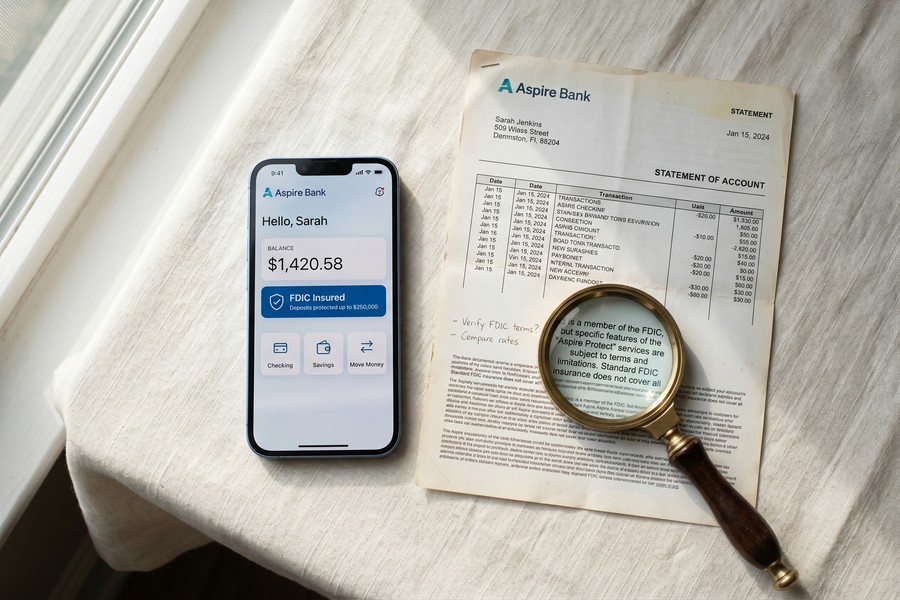
It does not mean the same thing, and the difference is specific enough to cost you real money. FDIC pass-through insurance only activates if the partner bank fails, not if the fintech platform itself fails, goes bankrupt, or shuts down. The FDIC explicitly warns consumers that nonbank fintech companies may or may not have insured bank relationships, and that deposit insurance does not protect against the default or bankruptcy of any non-bank entity.
The 2024 Synapse Financial Technologies collapse made this concrete. Synapse was a Banking-as-a-Service intermediary, an invisible middleware layer that sat between consumer-facing neobanks like Yotta and Copper and the partner banks actually holding deposits. When Synapse filed for bankruptcy, more than 100,000 account holders lost access to their funds for months. A $65–$96 million shortfall emerged between what customers had deposited and what partner banks could account for. The partner banks remained solvent. The FDIC insurance never triggered. The money was simply inaccessible, then partially missing, because the ledger system connecting consumers to their funds had collapsed.
There is a second, less-discussed risk here. If you bank with a neobank that uses, say, The Bancorp Bank as its FDIC-insured partner, and you also personally hold a direct account at Bancorp, your combined balances across both relationships count toward a single $250,000 limit per depositor ownership category. Most “switch to fintech” guides never mention this. The Federal Reserve, FDIC, and OCC issued a joint warning in July 2024 that misleading fintech marketing about FDIC pass-through coverage constitutes a regulatory violation, which tells you something about how widespread the confusion already was.
Before trusting any neobank with meaningful funds, locate the specific partner bank in the app’s terms of service, confirm it is an FDIC-insured institution at the FDIC’s BankFind database, and check whether you already have personal deposits at that same institution.
Mistake #2: Having No Backup When Your Account Gets Frozen
An account freeze at a traditional bank is an inconvenience. At a fintech-only setup, it is a financial emergency. Neobank terms of service routinely grant platforms broad discretion to freeze or close accounts “for any reason,” and automated fraud detection systems can flag entirely ordinary activity: a large direct deposit, several declined transactions in a short window, or unusual spending patterns that differ from your history.
Chime, Varo, and Cash App have all faced class-action lawsuits over wrongful account freezes, including cases where Social Security and disability payments were locked in accounts users could not access. The practical recourse is far more constrained than at a branch bank. There is no in-person escalation path. Phone support queues at major neobanks routinely run 30–90 minutes, and many disputes are routed through mandatory arbitration clauses buried in the terms of service.
The CFPB has warned explicitly that if a nonbank payment app’s business fails, a consumer’s money is likely lost or tied up in a lengthy bankruptcy process. A freeze is not a failure, but the same structural absence of consumer recourse applies. The fix is straightforward: keep a no-fee credit union or brick-and-mortar checking account open in parallel, funded with at least one month of essential expenses. You may never use it actively. That is the point.
Mistake #3: Not Solving the Cash Deposit Problem Before Switching
Most neobanks do not accept cash deposits directly. Full stop. Users who need to deposit cash typically must load it through retail partner networks: Walgreens, CVS, and Green Dot reload locations are the most common. Those transactions carry fees of $4–$5 per load and daily limits that vary by network but often cap at $500.
Run the arithmetic: a gig worker or tipped employee depositing cash once a week pays roughly $4.50 per transaction, which is $234 per year at minimum. A twice-weekly depositor pays $468 annually. That number directly erases the “no monthly fee” advantage that made fintech appealing in the first place. For context, the average monthly fee at a traditional bank runs about $12–$15, which is $144–$180 per year. The fintech setup ends up costing more for anyone depositing cash regularly, and this fee structure is rarely disclosed prominently during onboarding.
If you receive cash income with any regularity, map out your specific cash-loading options and costs before switching. A hybrid setup, where a fintech handles digital spending and a credit union handles cash deposits, often makes more sense than a full switch. This is one of several hidden costs that quietly drain your budget without appearing on any single line item.
Mistake #4: Underestimating the Credit-Building Gap Before a Major Loan
Fintech debit accounts, no matter how actively used, contribute nothing to your credit profile. Spending $3,000 a month through a neobank debit card for two years leaves no record at Experian, Equifax, or TransUnion. Lenders evaluating a mortgage or auto loan still rely on that record, and its absence is treated the same as a thin file.
According to FICO’s own data, 90% of top U.S. lenders still use legacy FICO scores as the primary underwriting tool. FICO’s UltraFICO score, updated via a Plaid partnership in late 2025, can now incorporate real-time cash-flow data from bank accounts. But this only helps borrowers who explicitly opt in, and most mortgage underwriters do not run it as the primary decision tool. Fintech-only users who plan a home purchase or car loan in the next 24 months and have no parallel credit product are largely invisible to traditional lenders.
The practical response is to open a secured credit card or credit-builder loan that reports monthly to all three bureaus, and to do it well before you need the loan. Credit history length matters in FICO scoring, which means the right time to start was 12–24 months ago and the second-best time is now. If your fintech setup is otherwise working, you don’t need to dismantle it. You need one credit product running alongside it. The broader risk of building wealth in too few places applies here too; the one-asset trap applies to banking relationships the same way it applies to investment portfolios.
The CFPB’s Issue Spotlight on deposit insurance coverage in payment apps found that many payment app companies invest users’ funds in loans and bonds rather than bank deposits, meaning those funds would not be eligible for deposit insurance coverage if the app fails. The report also noted that growth in fintech has blurred the distinction between insured banks and nonbanks in the eyes of consumers, a finding that applies directly to anyone relying on a fintech account as their sole financial safety net.

Who Should and Who Should Not Go Fintech-Only
Good candidates
Fintech-first banking works best for people whose financial lives are already mostly digital and who maintain at least one parallel traditional account.
- Salaried employees with direct deposit who never need to deposit physical cash and want high-yield savings without minimum balance requirements
- Frequent international travelers who want to eliminate foreign transaction fees on everyday spending
- Digitally active budgeters who benefit from real-time categorization, instant alerts, and AI-powered budgeting tools that many neobanks now integrate natively
- People with established credit histories who do not need a bank account to serve a credit-building function
Who should skip it
Going fintech-only is a poor fit for anyone whose financial safety net depends entirely on uninterrupted account access.
- People who receive government benefits (Social Security, disability payments, SNAP) as their primary income and have no backup account, given documented account-freeze risks at major neobanks
- Gig workers, freelancers, or tipped employees who deposit cash more than twice a month and would pay $200–$500 annually in loading fees
- Anyone planning to apply for a mortgage or auto loan within 24 months who has not yet established a bureau-reporting credit product
- People whose combined neobank and partner-bank balances exceed or approach the $250,000 FDIC per-depositor limit
Frequently Asked Questions
Is a neobank account actually FDIC insured?
Conditionally. Most neobanks partner with FDIC-insured banks and offer what is called pass-through insurance, which means your deposits are covered up to $250,000 if the partner bank fails. If the neobank itself fails or goes bankrupt, FDIC insurance does not automatically protect you, as the Synapse collapse demonstrated in 2024. Always verify the named partner bank before depositing significant funds.
Can going fintech-only hurt my credit score?
Not directly, but it creates a credit-building gap that can hurt your ability to borrow later. Neobank debit accounts do not report activity to Experian, Equifax, or TransUnion. If a fintech account is your only financial product, lenders evaluating a mortgage or car loan will see little or no credit history. Pair any fintech setup with at least one credit product that reports to all three bureaus.
What happens if my fintech account gets frozen?
You lose access to all funds in that account until the freeze is lifted, which can take days or weeks depending on the platform. Unlike a traditional bank, there is no branch to visit, and many neobanks include mandatory arbitration clauses that limit your legal options. The practical safeguard is keeping a parallel account at a credit union or brick-and-mortar bank funded with one month of essential expenses.
Which fintech apps are the safest to use as a primary account?
Neobanks that hold their own federal or state bank charter carry less structural risk than those that rely on a Banking-as-a-Service intermediary. SoFi Bank and Varo Bank both hold bank charters, meaning there is no middleware layer between you and an FDIC-insured institution. Before committing to any fintech as your primary account, confirm whether it holds a charter directly or routes deposits through a third-party BaaS provider, and check how long the company has been operating.
Sources
- FDIC, Banking With Third-Party Apps: What You Need to Know (2024)
- CFPB, Consumer Advisory: Your Money Is at Greater Risk in a Payment App (2023)
- CFPB, Issue Spotlight: Analysis of Deposit Insurance Coverage on Funds Stored Through Payment Apps
- Federal Reserve, FDIC, and OCC, Joint Statement on Banks’ Arrangements With Third Parties (July 2024)
- FDIC, 2023 National Survey of Unbanked and Underbanked Households (Released November 2024)
- Federal Trade Commission, Consumer Sentinel Network Data Book 2024 (Released March 2025)
- OCC, Bulletin 2024-20: Third-Party Relationships and Bank-Fintech Arrangements
- Bankrate, Digital Banking Trends and Statistics 2025